FREQUENCY RESPONSE
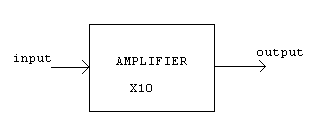
A perfect amplifier with an amplification of times 10, as shown above, would give an output 10 times greater than the input, NO MATTER WHAT THE INPUT FREQUENCY.
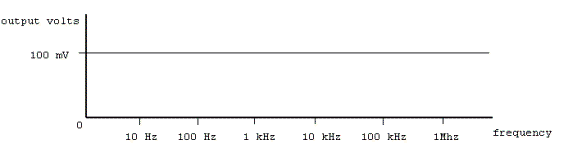
If the input was 10 mV then the output would be 100 mV, no matter the frequency of the input signal, as seen in the graph below.
This graph is known as a FREQUENCY RESPONSE diagram
In a practical amplifier it is not possible to obtain a perfectly flat response curve.
This is due to limitations of electronic components and circuitry.
Usually there is a fall of response at low and high frequencies
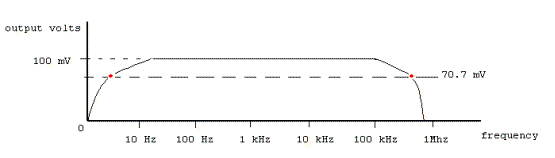
The two points in red on the response curve mark where the output of the amplifier has fallen to 70.7 % of the maximum output.
This means that that the 100mV output has fallen to 70.7 mV at these frequencies.
These are called the -3 dB points.
One is at about 5Hz (call it f1).
The other is at about 900 kHz (f2).
Subtract f1 from f2 to get the BANDWIDTH of the amplifier.
In this case it is just under 900 kHz wide.
In some cases the bandwidth is tailored to pass some frequencies and not others.
This is called FILTERING.
Measuring Current
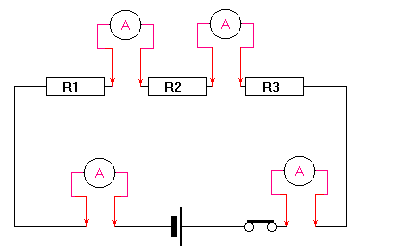
To measure current the circuit must be BROKEN and the meter inserted in the break.
In this circuit the current will be the same no matter where the circuit is broken. If 1 amp is flowing then all meters will indicate 1 amp.
Observe the polarity of the leads when measuring DC
This is not necessary when measuring AC.
Select a high current range on the meter before switching the circuit on.
Switch down to a lower range if necessary to measure the current.
This protects the meter from damage due to excessive current, especially a moving coil one.
Measuing Voltages
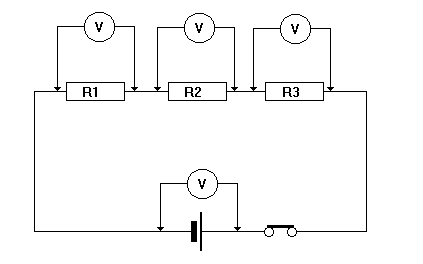
To measure voltages, the meter must be connected ACROSS things; across resistors, across the battery etc.
When measuring DC, connect the red meter lead to the most positive point, and the black one to the most negative.
When measuring AC voltages it doesn't matter which way the leads are connected.
It's best to select a high voltage range on the meter before connecting it and then switching to a lower range if necessary.
This protects the meter, especially moving coil ones, from being damaged by having too high a voltage applied to them.
