Measuring Resistance
When measuring resistance the power to the circuit must be SWITCHED OFF.
Ensure that there are no components in parallel with the component to be measured.
There is no need to observe the polarity of the leads.
Signal Generator
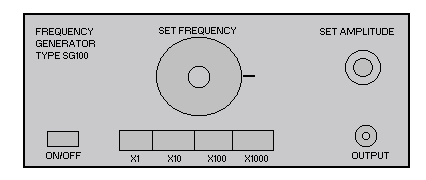
The signal generator is a source of signals for testing and measuring purposes.
Most commonly they generate sine waves.
Audio signal generators produce signals in a range from a few Hertz up to several Kilohertz.
Signals can be injected into audio amplifiers to see how they behave at various audio frequencies.
Amplification and frequency response can be measured and distortion of the signal can be observed.
Radio frequency generators can provide frequencies from about 100 Kilohertz up to several hundred Megahertz.
With radio frequency generators it is usually possible to modulate the R.F. with an audio signal to simulate a radio station. Amplitude and frequency modulation are available.
Using an R.F. generator the various tuned circuits in a radio can be adjusted for peak performance.
The picture is of a simple generator with on/off and frequency and amplitude controls. The large control knob in the centre selects the base frequency while the four switches below select a multiplier.
For example if the base frequency is 30 Hertz and the multiplier is X10 then the output signal is 300 Hertz.
Generators producing square waves, sawtooths and triangular waves etc are called function generators.
Generators can be used in the location of faults in non-working equipment.
Effect of Meter Resistance
All meters have resistance.
The value of this resistance depends upon the voltage range selected.
A typical moving coil meter has a SENSITIVITY of 20,000 ohms per volt.
This means that when the 1 volt range is selected the meter has a resistance of 20,000 ohms.
When the 10 volt range is selected it has a resistance of 200,000 ohms and so on.
When the meter is connected to a circuit to measure voltage, this resistance will affect the circuit and therefore the accuracy of the measurement obtained.
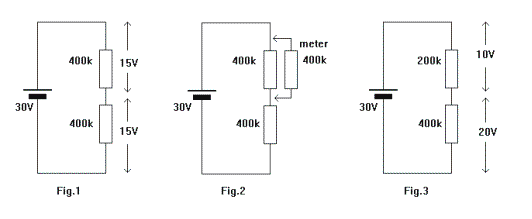
In Fig.1 the voltage across each resistor can be calculated.
However, it can be shown that since the resistors are of the same value then the battery voltage divides equally across them, and the voltage across each will be 15 volts.
Now if we set the meter to the 20 volt range to measure this voltage, its resistance will be 20 x 20,000 = 400,000 ohms = 400k.
If we connect it across the top resistor, as in Fig.2 then we have two 400k resistors in parallel.
Calculating the result of this gives us 200,000 ohms and the circuit looks like Fig.3
The voltage will now divide to give 10 volts across the top resistor and 20 volts across the lower resistor.
The meter will indicate 10 volts when we know that it should indicate 15 volts.
Similarly, connecting the meter across the lower resistor will again indicate 10 volts.
It appears that there is 10v + 10v = 20 volts across the two resistors, when in fact there is 30 volts.
To obtain the most accurate results, set the meter on the highest range possible.
This means that its resistance will be highest and have least effect on the circuit.
Digital meter have a very high resistance, typically 10 Megohms on all ranges, and the readings obtained are more accurate than those obtained using a moving coil meter.
When buying a new meter look for a sensitivity greater than 20,000 ohms/volt.
